370 Ki Biryani: The ₹370 Which Shok The Indian Internet
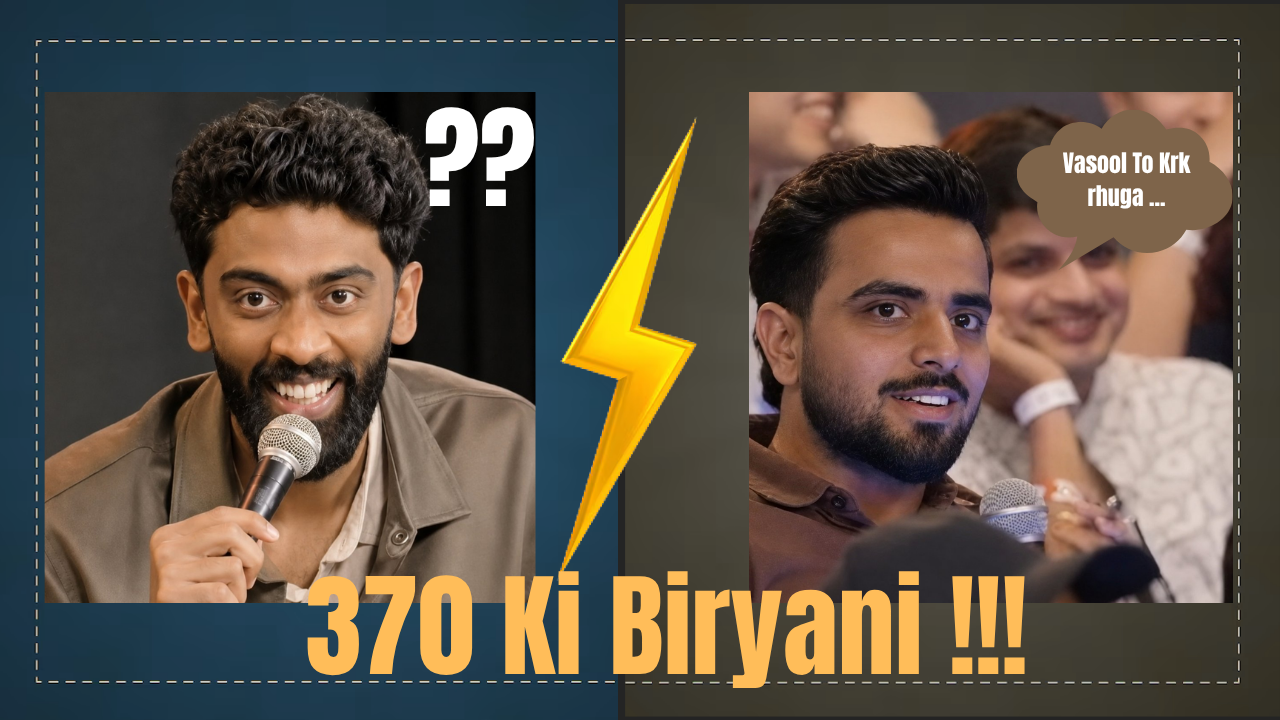
The clip that went viral, says Himanshu that he went on a date with a girl and paid around ₹370 for a chicken biryani. The tale began rather ordinarily.

The Drift Hub
Published: • 5 min read
Share Story
Every couple of months the Indian Internet comes up with a fresh national obsession. It can be a dance craze, it can be a cricket moment or it can be some plate of ₹370 biryani. Of course the much talked about “370 Ki Biryani” meme is making its way into the “Indian Meme Hall of Fame” and yet again, social media has been the set-up for a random conversation becoming a nation-wide event in no time.
However, unlike most memes that emerge out of nowhere, “370 Ki Biryani” meme dates back to a particular incident of comedian Pranit More’s circus of comedians in the middle of a crowd-work comedy show. If you are not familiar with crowd-work, it is a form of stand-up where the comedian communicates directly with the audience and constructs his or her comedy on your personal anecdotes. In one such incident, Pranit asked a member of the audience, now identified as Himanshu Jangra from Gurugram, to come up on stage and share an interesting experience of dating. Who would have thought that the narrative would become one of the most appreciated meme stories in the Indian subcontinent a few days later?
The clip that went viral, says Himanshu that he went on a date with a girl and paid around ₹370 for a chicken biryani. The tale began rather ordinarily. People go on dates and pay for food countless times a day. The dialogue shifted however when the woman said to him, that after eating, she asked him to take her home. The moment was captured and he hit the perfect delivery: “₹370 ki biryani khilayi hai, wasool toh karunga.” He got immediate applause from the crowd, Pranit More had the idea struck right away and in a matter of days, the clip was upvoted across Instagram, YouTube Shorts, X, Facebook, Reddit and WhatsApp groups nationwide.
The statement went viral not because of biryani, but because of the funny thing of thinking that the biryani is a big investment and is expected to give returns of Rs 370. The statement was met with a lot of mockery at the moment by social media users. If one spends ₹370 in biryani, then one should enjoy special privileges, Memers joked, adding that if that applies to the biryani then it should be the same for the movie goers with movie tickets who should own part of the movie hall and those who buy a smartphone should become shareholders of the company. As a group, the people of the internet determined that ₹370 no longer had to be a price, it had to be a financial instrument.
The meme eventually branched off from the original context. After spending money on coffee, petrol or fast food, the creators of Instagram began creating skits on “recovering investments. X users made comparisons between ₹370 biryani and startup funding rounds and Reddit communities have developed imaginary economic theories around “Biryani ROI. Some even cracked jokes that now ₹370 was a part of the generational wealth. Some people said that people who have paid ₹370 should have the right to vote in the restaurant’s meetings. Every retelling of the joke was even more ridiculous, and the funnier it got the more it was told.
What’s great about the meme is its flexibility. It can be used to mock unrealistic expectations, poor financial decisions, one-sided relationships, bad investments, or anyone that wants too much for too little. Like the most successful memes in India, their significance varies according to circumstances. Here it’s about the dating culture, then next day it’s about business failures and then it’s about cricket, engineering placements, stock market investments by the weekend.
Internet detectives would of course be present to try and explain any viral Indian meme. The meme grew popular and thousands of people started dissecting all the elements of the original clip, discussing if it was a serious claim, sarcastic or just a joke that was misapplied. In the meantime, most viewers were just having fun watching a ₹370 biryani become the centre of a country-wide discussion. The more people tried to explain the joke, the funnier it was.
The meme also contributed to the conversation about contemporary dating practices. Some users thought the statement was problematic because paying for a meal should not be expectations. Others praised it as a harmless stand-up session from their crowd. Like so many viral Internet moments, what the video said was soon lost in the reactions it got . The debate itself just helped keep the meme alive, as most viral clips would have died after.
The “370 Ki Biryani” is interesting in that it captures the essence of Indian internet culture. The Indians can make an ordinary event a national joke like no one else can. Millions of people were able to see the absurdity, relatability and comedic potential in a single sentence from a random interaction in a comedy show, making it a cultural phenomenon. The joke got devoured by the internet, then thousands more times.
Today, “370 Ki Biryani” is a classic example of how today’s memes are made. A free-wheeling tale told in a comedy routine left the stage and was picked up by millions of creative brains and grew to a size beyond the stage’s imagination. Whatever happens to the meme, be it months or the eventuality of it being buried in the archives of internet history, one thing is sure, somewhere in India, a plate of biryani with a price tag of ₹370 won’t ever be called a plate of biryani again.
“370 Ki Biryani” has made itself at home in the grand museum of Indian meme culture, where logic is never in the equation, sarcasm is a must-have and every viral trend gets the royal treatment. Unlike the original date, the entire internet came to reap the fruits of its return on investment this time.